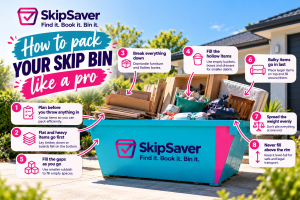
How to Fit More in Your Skip Bin: 9 Packing Tips

You’ve paid for the skip, so you want to use every bit of it. The difference between a well-packed bin and a messy one can easily be a whole extra trailer load, or the difference between one bin and two. Here’s how to pack like a pro.

1. Plan before you throw anything in

Take ten minutes to look at what’s going in. Group bulky items, flat items and loose rubbish. Knowing what you’ve got stops you from filling the bin with awkward items early and running out of room later.

2. Flat and heavy items go first

Start with flat, heavy things like doors, panels, sheets of plasterboard or timber boards. Lay them flat on the bottom to create a solid base.

3. Break everything down

Dismantle furniture, remove legs from tables, take doors off cupboards and flatten cardboard boxes. A bookshelf standing upright wastes a huge amount of space. In pieces, it fits neatly along the side.

4. Fill the hollow items

Buckets, drawers, boxes and pipes have empty space inside. Fill them with small debris before they go in.

5. Fill the gaps as you go

After each layer, use smaller rubbish such as offcuts, broken tiles and bagged waste to fill gaps. Think of it as a game of Tetris.

6. Bulky items go in last

Awkward items like mattresses (if your supplier accepts them) or chairs are best placed on top of a solid layer, where you can fill around them.

7. Spread the weight evenly

Don’t pile everything at one end. An unbalanced bin can be unsafe to lift, and drivers may refuse to collect it.

8. Never fill above the rim

This is the big one. Skips must be level-full to be transported safely and legally. An overfilled bin can mean extra fees, a delayed pick-up or you having to unload part of it.

9. Keep banned items out

Paint, chemicals, gas bottles, batteries, tyres and asbestos usually can’t go in a standard skip. Finding them at the tip can mean extra charges, so check your supplier’s list first.

Still running out of room?

If you’re consistently overfilling, you probably need the next size up. Going up one size often costs less than a second bin or overfill fees. Our skip bin size guide can help you choose, and our list of common skip hire mistakes will help you avoid the rest.

Compare skip bin quotes in minutes

SkipSaver lets you compare prices from local skip bin suppliers and book online in a few clicks. No phone tag, no guesswork. Get your free quotes now.
What Can’t Go in a Skip Bin? A Guide to Banned Items

Skip bins make clean-ups easy, but not everything can go in them. Throwing in the wrong item can mean extra charges, a refused pick-up or, in some cases, a fine. Here’s a quick guide to what’s usually banned and how to get rid of it properly.

Why are some items banned?

Skip bin waste is sorted and taken to recycling facilities and landfill, which operate under strict environmental and safety rules. Hazardous materials can harm workers, contaminate soil and water, or start fires in trucks and facilities. Some items, like electronics, are also restricted from landfill in parts of Australia because they contain valuable materials that can be recovered.

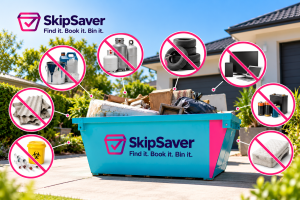
Items that usually can’t go in a skip

  • Asbestos: must be handled and removed under strict rules, often by a licensed removalist. Never put it in a general skip.
  • Paint, solvents and chemicals: including pool chemicals, pesticides and oils.
  • Gas bottles and aerosols: these can explode under pressure.
  • Batteries: especially lithium-ion batteries, which are a major fire risk in waste trucks.
  • Tyres: usually need to go to a dedicated tyre recycler.
  • Electronics (e-waste): TVs, computers, phones and cables are banned from landfill in several states and are best recycled.
  • Food and liquids: these attract pests and create odours.
  • Medical and clinical waste: including syringes.

Items that may cost extra

Some items are accepted by certain suppliers but attract an extra fee because they need special handling:

  • Mattresses
  • Fridges and freezers (because of the gas they contain)
  • Large tree stumps
  • Heavy materials like soil, concrete and bricks, which may need a dedicated bin

Always check with your supplier before loading these.

What to do with banned items instead

  1. Check your council. Many councils run household hazardous waste drop-off days or have permanent drop-off points for paint, gas bottles, batteries and chemicals.
  2. Use recycling programs. National schemes and many retailers collect e-waste, batteries and mobile phones for free.
  3. Book a specialist. For asbestos, use a licensed removalist. For tyres, contact a tyre recycler or retailer.
  4. Donate or sell. Working appliances, furniture and electronics can go to op shops or online marketplaces.

When in doubt, ask

Rules differ between suppliers, councils and states, so if you’re unsure about an item, ask your skip supplier before it goes in. It takes a minute and can save you a surprise bill. For more tips, see our list of common skip hire mistakes.

Compare skip bin quotes in minutes

SkipSaver lets you compare prices from local skip bin suppliers and book online in a few clicks. No phone tag, no guesswork. Get your free quotes now.
Green Waste Disposal: Your Options Compared

Whether you’ve just pruned the hedges, pulled out an overgrown garden bed or taken down a tree, garden waste piles up fast. Most Australian households have several ways to deal with it, and the right one depends on how much you have and how quickly you want it gone.

What counts as green waste?

Green waste generally means organic garden material: grass clippings, leaves, prunings, branches, small logs, weeds and flowers. It does not usually include soil, rocks, turf with lots of dirt attached, treated timber, plastic pots or general rubbish. Mixing these in can turn a cheap green waste load into an expensive general waste one.

Option 1: Your kerbside garden or FOGO bin

Many councils provide a garden organics bin, and more are rolling out FOGO (food organics, garden organics) collections. It’s the cheapest option, since it’s usually covered by your rates, but it’s best for ongoing garden maintenance rather than big clean-ups.

Option 2: Council bulk or verge collections

Many councils run scheduled green waste collections once or twice a year, or let you book a pick-up. They’re often free, but you’re working to the council’s timetable, there are rules on bundling and pile size, and material can sit out the front for a while.

Option 3: Drop it at a transfer station

If you have a trailer and only a load or two, your local transfer station or tip is an option. Green waste is often cheaper to drop off than general waste, and some councils offer free tip vouchers to residents. Factor in the time, fuel and effort of loading and unloading.

Option 4: Hire a green waste skip bin

For bigger jobs, such as a full garden makeover, tree removal or clearing a block, a dedicated green waste skip is usually the easiest choice. You fill it at your own pace and it’s taken away when you’re done. Because clean green waste can be mulched and composted, green waste skips are often priced lower than general waste bins of the same size.

Weighing up a green-only bin against a general rubbish skip? We cover that in green waste bins vs general rubbish skip hire.

Tips for a smooth green waste skip hire

  • Keep it clean. Even a few bags of household rubbish can see your load reclassified and charged as general waste.
  • Cut branches down. Shorter lengths pack tighter, so you fit more in.
  • Ask about soil and stumps. Many suppliers treat these separately because of their weight.
  • Time it with the season. Spring and autumn are peak pruning times, so book ahead.

Where does it end up?

Clean green waste is commonly shredded and processed into mulch and compost, which goes back into gardens, parks and farms. Disposing of it properly keeps valuable organic material out of landfill.

Compare skip bin quotes in minutes

SkipSaver lets you compare prices from local skip bin suppliers and book online in a few clicks. No phone tag, no guesswork. Get your free quotes now.

The Weekend DIY Guide to Small Skip Bin Hire

Saturday morning, coffee in hand, and a list of jobs that has been growing for months: the shed, the spare room, that pile of old pavers behind the garage. A weekend project is the perfect time to finally get on top of it, and a small skip bin is often the easiest way to make the rubbish disappear when you’re done.

Here’s what you need to know to get the right small skip, avoid surprise fees and finish the job without a single trip to the tip.

What counts as a “small” skip bin?

Most Australian suppliers class bins from about 2 to 4 cubic metres as small. To put that in perspective, a 2m³ bin holds roughly the same as two to three box-trailer loads, and a 4m³ bin is closer to five or six.

  • 2m³: a single room declutter, a small garden tidy-up or clearing out a laundry.
  • 3m³: a bathroom strip-out, a shed clean-out or a medium garden job.
  • 4m³: a small kitchen reno, a garage clean-out or a combination of jobs.

Not sure which one you need? Our guide to choosing the right skip bin size walks you through it.

Why a small skip beats the trailer

Borrowing a trailer sounds cheap until you add up fuel, tip fees, your time and the back-breaking job of unloading it again. A skip lets you load as you go, at your own pace, and someone else takes it away when you’re finished. We’ve compared the costs in skip bins vs trailer runs.

Plan your weekend in four steps

  1. Book early in the week. Weekend delivery slots fill fast, especially in spring and summer. Booking by Wednesday gives you the best choice of suppliers and prices.
  2. Pick your spot. Choose a flat, hard surface with easy truck access, usually the driveway. If the bin has to go on the verge or road, check with your local council first, as a permit may be needed.
  3. Sort before you load. Pull out anything that can be donated, sold or recycled. You’ll free up space in the bin and give your stuff a second life.
  4. Know what can’t go in. Asbestos, paint, gas bottles, batteries, tyres, electronics and chemicals are almost always banned. Check the supplier’s list before you start.

Loading tips that save space (and money)

  • Break down boxes and flat-pack furniture.
  • Put heavy, flat items on the bottom and fill the gaps with smaller rubbish.
  • Never fill above the rim. Overfilled bins can’t legally be transported, and you may be charged extra or asked to remove the excess.

What does a small skip cost?

Prices vary by location, bin size, waste type and hire length, so the best way to know is to compare. Two quotes for the same bin in the same suburb can be surprisingly different, which is exactly why we built SkipSaver.

Compare skip bin quotes in minutes

SkipSaver lets you compare prices from local skip bin suppliers and book online in a few clicks. No phone tag, no guesswork. Get your free quotes now.